Thursday, December 12, 2013

It's Winter Break Time

We just wrapped up our Fall Programming season this week at our library.  We divide our program year into quarters and always have a break in between, ranging from two to four weeks.  We use the time to plan storytimes and other programs, develop a new story or two, and put some energy into sometimes-neglected parts of our jobs, such as collection development (not like we don't do that all year, it's just that December's a great time to catch up).
quarters and

So I'm afraid I won't be posting any new stories here for about a month.  Weekly posts will resume around January 15th.  Meanwhile, I'll continue to post a new video each week on the "Storytelling with Puppets" youtube channel.  Coming this weekend:   "Anansi the Spider" by Gerald McDermott.

Wednesday, November 27, 2013

Extraordinary Animal Friendships, with Scans and Music


Book:  Friends: True Stories of Extraordinary Animal Friendships  by Catherine Thimmesh
Puppets:  None
Props:  None
Technology:   Scanned Images Projected with PowerPoint;  Music
Presenters:  One
Audience:   Family Storytime  (mostly 3-7 year olds)

We use scanned images and PowerPoint in a variety of ways during our programs.  Sometimes it's just to make sure that our large crowds can see the excellent artwork....we call that a "straight scan," where we just show the pictures and read the words.  But more often we do something a little different.  One of my favorites is when we add music, which we did this week for our "Family and Friends" theme in Family Storytime.
Friends is a very cool book by Catherine Thimmesh.  She briefly tells the story of unusual animal friendships, and accompanies each story with a great photo of the pair.  We've tried this three different ways in our Family Storytime and finally got it right.  First we scanned the images and told the story of each pair in a couple sentences, shortening from the text for our mostly preschool audience.  It was fine, but a little too much for the kids to absorb.  So the next time we added music:  a nice instrumental version of "What a Wonderful World" (the one that was a hit for Louis Armstrong, not the Sam Cooke).  We played that medium-low while we narrated over the music....still too much.

Then Sheila had the solution:  No words at all, just show the pictures with music to accompany.  And it worked great.  We used "You've Got a Friend in Me" by Randy Newman (the kids know it from Toy Story).  We showed each image for about 10-15 seconds and clicked to the next, which fit perfectly for the two minute song.

Just focusing on the images allowed the kids to easily follow it and enjoy it without trying to absorb the back stories of each.  Just seeing the frog floating with the mouse on its head, or the monkey resting its head on the bird is enough to keep them absorbed.  We let them know it's fine to talk to each other during the story, because they're really eager to identify the animals and marvel at the unexpected combinations.

The music was light-hearted and fun, matching the mood of the photos.  And although we didn't use the words, we generated strong interest in the book, which doesn't work well for a large group in its entirety, but can be an excellent one on one read aloud at home.  We also pulled a bunch of other animal friend photo essays together for our book display and lots of those checked out too.  Titles include Koko's Kitten, Owen & Mzee, A Friend for Einstein, and several others.  It's a great way to promote non-fiction in a storytime.

Another fun music/scans combo is the one we did for our K-2 Book Adventure "Foods" program, using Saxton Freymann's food photo books.  Details are at the beginning of our Program Summary for our K-2 Book Adventure "Foods" program which we did a couple years ago (and just repeated last week).

And I really liked the way music worked with Mo Willems' & Jon Muth's City Dog, Country Frog.  We did narration with that one, along with four different music samples (one for each season).

We're lucky, of course, to have a built in projector in our story room, so we can project from the ceiling without having to have a projector on a table.  We got an iPad a few months ago and have added AppleTV which allows you to project from that screen...haven't quite explored the possibilities there, but we're still finding plenty of fun stuff to do with old fashioned PowerPoint.  For other examples you can click on the "Projector" label in the column on the right.,..


Sunday, November 17, 2013

Elephant and Froggie (aka Piggie)

Book:  I'm a Frog  by Mo Willems
Puppets:  None
Props:  Pig stuff, Elephant stuff, but really just pink shirt/gray shirt will do
Presenters:  Two   (also works as a one-person puppet story)
Audience:  Family Storytime
Video:  How to Tell I'm a Frog with Puppets

With a "Mo Willems Celebration" as our Family Storytime theme, Sheila and I were planning on doing Listen to My Trumpet, which we hadn't tried before....but Mo's latest, I'm a Frog, came in just a week before, and we knew we had to do this one instead.  It works great as a two-person act out.

Piggie (Sheila) starts behind a backdrop, and when Gerald looks for her she "ribbits," then hops onto stage.  And, as usual with the E & P books, we stick to the just-right dialogue straight from the pages.  Even though there aren't that many words, the back-and-forth has to be in the right order and with the right timing, so it does take a few run throughs to get it right.  It helps me to kind of break the story down into sections:

First it's Gerald reacting to the fact that Piggie is pretending to be a frog.  We take it kind of slow, making sure we give the audience time to react to Piggie's hopping and ribbiting and fly catching, and to Gerald's concern.  This section ends with Gerald stating:  "You learn something every day!," which comes up again later.

Then it's Gerald freaking out when he realizes that Piggie is a frog and the same could happen to Gerald.

Then Piggies explains about "pretending" (with the "You learn something..." refrain repeating).

And finally Piggie tells Gerald he can be a frog too, which leads to a fun "No I can't! / Yes you can" back and forth.  The conclusion is perfect, as Gerald reveals that he can't be a frog, because..."I am a cow.  Moo!"

We struggle from time to time with stories that have punch-line endings where we're never quite sure that all the kids, especially the 3's and 4's, really get.  And sometimes we add a clarifying line or something.  But this one is right at their level and everyone gets the joke.

Really, there's not too much to say about this one as an act-out, because it works so naturally and easily.  You can't really say Gerald or Piggie's lines without getting into their characters.  You don't even have to do much in the way of costume.  A simple pig/elephant hat or ears works, and we've even done E & P's just by wearing pink and gray.

This also works great as a one-person puppet show, and there's a video demo here.  I've added a "Label" on the bar at the right called "Video - Storytelling with Puppets" which gets you to all of the posts on this blog that also have a link to a YouTube video demo.

Sunday, November 10, 2013

Slightly Spooky Dust Bunnies

Book:  Here Comes the Big Mean Dust Bunny by Jan Thomas
Puppets:   None
Props:   Dust Bunny costumes
Performers:  Five
Technology:    PowerPoint slides
Audience:  Family Story Time

We typically have two people do our Family Storytimes, and many (but not all) can also be done with one, but for this one you really need four or five.  So I know this means many libraries couldn't do this story this way, but we just had so much fun with it I have to tell it anyway.

With our annual "Slightly Spooky Stories" event we always use all five of us children's staff (Shannon, Brad, Sheila, Terri, and myself) and try to find stories where we all have stuff to do.  We had done Jan Thomas' Rhyming Dust Bunnies before as a two person puppet show (details here) and we all knew about this sequel, but never thought to try it until this storytime came up.  We realized we had enough people to have four Rhyming Dust Bunnies (RDBs) plus the Big Mean Dust Bunny (BMDB), but then decided to mix acting out (the RDBs) with PowerPoint scans from the book (the BMDB).  Jan Thomas' illustrations, with her thick black lines and bright colors, come through really well on the screen.  


For costumes, we happened to have a bunch of frilly skirts that are worn quite often in storytimes (though not so much by me and Brad).  Turns out if you wear one around your neck instead of around your waist and then tie a scarfy kind of thing around your head, you look just like a dust bunny.  Well not just like, but close enough.  So the four RDBs entered, sort of spinning around and bumping into each other, then went into the simple words from the book.  We had the words show up on the screen, which is a neat way to reinforce the rhymes.  It also helped us remember what to say.


The the Big Mean Dust Bunny appears as an image filling the screen, while Brad is offstage doing his lines with a microphone.  We did some simple PowerPoint animations to get the action into the story:   

1.  When the BMDB uses "Sit!" as the rhyme, the four RDB's get directly under the image on the screen, then pretend to get squished as the image moves down to the bottom of the screen.

2.  When the BMDB uses "Chase!" his image moves back and forth across the screen a couple of times, while the four RDB's run back and forth across the stage area, trying to stay in front of the image (which is harder to do than you'd think)

3.  When the BMDB gets squished by the Cat (Bob tried to warn him), had a sideways image of the BMDB that was squished, then two RDB's on each side pretend to pull it.  Each click switches to a less-squished version of the image, so it kind of look like the BMDB is getting stretched out to full size as we pull. 

Sometimes when we try to mix screen images and acting out it can be a little complicated, but in this case I thought the two styles mixed very smoothly.  I'm pretty confident that no one in the audience was really scared by this one, but that's why we call it "Slightly Spooky Stories."  

Sunday, October 27, 2013

Mo Willems Has Yet Another Good Idea

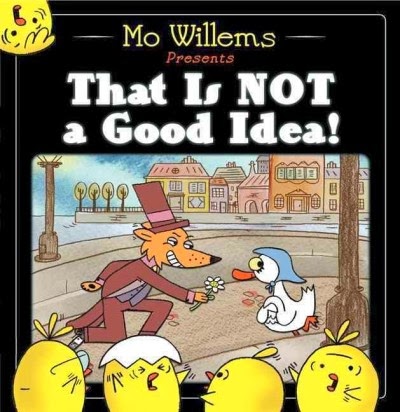
Book:  That Is NOT a Good Idea!  by Mo Willems
Puppets:    Goose, Wolf (or Fox), Goslings (3-5)
Props:    Pot (big enough to fit Wolf puppet); Veggies (optional) Puppet Stage (optional)
Presenters:   2, plus 2-4 kids from audience
Audience:   Family Storytime (mostly 3-6 year olds)

Not all Mo Willems books are easily adaptable for presentation, but that doesn't mean we don't look carefully at every new one that comes along.  It took a bit of tinkering, but That Is Not a Good Idea! worked out very nicely when Sheila and I had "Mo Willems" as our Family Storytime theme last week.  In the book, Fox tempts Goose to accompany him, step by step, to the woods, to his kitchen, and into his soup pot.  Goose plays along and has a trick of her own at the end.  Meanwhile Goose's little Goslings act as a kind of a chorus:  Each time Goose agrees to one of Fox's sly suggestions, they yell out the title of the book.  The joke is that they're really warning Fox, not Goose, that things will end badly for him.

We used our puppet stage and regular hand puppets for Goose (maybe not technically a goose, but Sheila made this great bird puppet years ago and I use it every chance I get) and Wolf (we have a Fox puppet, but our Wolf is just a bit more expressive).  They appear on stage, Wolf makes a suggestion ("Shall we walk in the woods...?"), Goose agrees, then both exit. 

For the chorus of Goslings, we scanned, enlarged, and laminated the guys from the book, then stuck them onto paint sticks.  My original idea was that they would appear above the puppet stage, looking down on the other two.  Then Sheila had a better idea:  we had four kids from the audience come up to hold one Gosling each next to the stage, while Sheila held the first one.  This worked even better for their "chorus" role.  Sheila ran them through their line before we started, adding that they would say "really not..." then "really really not..." and so on.  She also encouraged the rest of the audience to join in on the refrain, and they did. 

We didn't bother with any backdrops; Wolf just said: "Now that we're in the deep dark woods..." and that was enough.  Each time the audience chimed in with the "..not a good idea" part, Wolf would pop back up and say something:  "you be quiet," or "it is too a good idea."  That's not in the book, but we felt like adding interaction between Wolf and Goslings helped establish the chorus' role and Wolf's plans.

When it's finally time for soup, Wolf puts a big plastic pot on the stage, adds a few vegetables to draw it out (and a lollipop just to be silly) and finally prepares to add the last ingredient, which everyone thinks will be Goose.  The Goslings give their last warning, then Goose grabs Wolf and stuffs him in the pot.  First, though, she explains that the Goslings "did try to warn Wolf..."   We wanted to make that clever twist very clear to everyone in the audience, short of spelling it out directly.  

Once Wolf is in the pot, Goose calls the Goslings down to have lunch with her.  The kids bring their stick figures over, Goose takes a bite or two of Wolf, and the kids, following Sheila's lead, have their Goslings gather round the pot for their own share.  Sometimes we find simple ways to soften the ending of a story that ends gruesomely, trying to respect the delicate nature of three and four year olds without compromising the story.....not this time.  We just followed the perfect ending of the book and that Wolf got eaten up.  The story was just so silly and so neatly constructed, it was by far the most satisfying way to end it (for the storytellers, as well as for the hungry geese). 


Wednesday, October 16, 2013

Fat Cat Tries to Sit on People (not puppets)

Book:  What Will Fat Cat Sit On?  by Jan Thomas
Puppets:  None
Props:   2 Signs each for Cows, Chickens, Pigs, Dogs, 1 each for Cat and Mouse
Presenters:   2, plus 4 child volunteers
Audience:  Family Storytime (mostly 3-6 years old)

I've enjoyed doing What Will Fat Cat Sit On? with puppets, and it was even my first post on this blog (January 17, 2011).  Terri and I decided to do it as an act-out for our "cats" themed Family Storytime.  In the story, Fat Cat half-threatens to sit on five different animals, so we decided to use kids for four of those, with Terri as Mouse, who comes in at the end.  Sometimes with stories like this we've had kids hold puppets or have something on their heads to identify the animals, but this time we just decided to have them hold a mask, laminated and mounted on a paint stick.  Some of the kids put the masks in front of their faces, some held them at their chest and either way works.  We had some store-bought farm animal masks for Cow + Chicken + Pig already that we'd used for a different story.  Then for Cat, Dog, and Mouse, we scanned, enlarged,

and laminated face pictures from the books.

Having the masks on sticks makes it real easy to switch, so we decided to have Terri and a child as each animal (except Mouse).  That way Terri could cue the kids and supply some of the personality, but it also gives the kids enough room to get into it too (and some did, some didn't).  I was thinking maybe I should stuff my shirt with a pillow to make a really fat cat, but Terri said don't worry about it:  curved arms, big wide steps, and a deep, goofy voice is all you need....and she was right, as usual.  
 
So first I come out as Fat Cat, wondering what I should sit on.  All four kids are sitting on small chairs, while Terri is behind the backdrop poking the Mouse mask out and back, which the kids see, but I don't, to sort of preview the Mouse ending (and parallel what Jan T. does with her illustrations).  Then Terri comes out, grabs a Cow mask and steps up with the Cow child as Fat Cat notices them and says:  "Will Fat Cat sit on...the cows?"  Then there's a short, slow chase as Fat Cat takes big steps towards the cows, circling them, until the cows say:  "Sit on the Chickens!"  The pattern continues with Chickens and Pigs, then shifts a bit when the Dogs growl and Fat Cat runs away.  

In the book, it's only the Chicken who tells Fat Cat to sit on someone else, but Terri had the good idea to do this for each animal, to really make the transition clear to the audience and to give the child volunteers a little more of an active role.   When Mouse comes out, Fat Cat repeats the big "What will Fat Cat sit on?" refrain, getting closer and closer to Mouse, who finally suggests the chair.  Each time we did this, when Fat Cat sits on the chair, the audience thought it was over, making the final twist ("Now....what will Fat Cat have....to EAT?!") even more fun.  Fat Cat gets off the chair and we have another slow chase as all the animals take off.  

To give it a nice clear conclusion, after chasing the animals I say one more "What will Fat Cat eat?" and pull a carrot out of my pocket.  Not in the book, but it worked just right for this presentation.  For two of our four performances we had a third teller, Carson Mischel (a visiting children's librarian from the nearby West Linn Public Library), and this story worked fine with three too.  Carson took the Mouse part, leaving Terri to do the other animals.