Sunday, November 10, 2013

Slightly Spooky Dust Bunnies

Book:  Here Comes the Big Mean Dust Bunny by Jan Thomas
Puppets:   None
Props:   Dust Bunny costumes
Performers:  Five
Technology:    PowerPoint slides
Audience:  Family Story Time

We typically have two people do our Family Storytimes, and many (but not all) can also be done with one, but for this one you really need four or five.  So I know this means many libraries couldn't do this story this way, but we just had so much fun with it I have to tell it anyway.

With our annual "Slightly Spooky Stories" event we always use all five of us children's staff (Shannon, Brad, Sheila, Terri, and myself) and try to find stories where we all have stuff to do.  We had done Jan Thomas' Rhyming Dust Bunnies before as a two person puppet show (details here) and we all knew about this sequel, but never thought to try it until this storytime came up.  We realized we had enough people to have four Rhyming Dust Bunnies (RDBs) plus the Big Mean Dust Bunny (BMDB), but then decided to mix acting out (the RDBs) with PowerPoint scans from the book (the BMDB).  Jan Thomas' illustrations, with her thick black lines and bright colors, come through really well on the screen.  


For costumes, we happened to have a bunch of frilly skirts that are worn quite often in storytimes (though not so much by me and Brad).  Turns out if you wear one around your neck instead of around your waist and then tie a scarfy kind of thing around your head, you look just like a dust bunny.  Well not just like, but close enough.  So the four RDBs entered, sort of spinning around and bumping into each other, then went into the simple words from the book.  We had the words show up on the screen, which is a neat way to reinforce the rhymes.  It also helped us remember what to say.


The the Big Mean Dust Bunny appears as an image filling the screen, while Brad is offstage doing his lines with a microphone.  We did some simple PowerPoint animations to get the action into the story:   

1.  When the BMDB uses "Sit!" as the rhyme, the four RDB's get directly under the image on the screen, then pretend to get squished as the image moves down to the bottom of the screen.

2.  When the BMDB uses "Chase!" his image moves back and forth across the screen a couple of times, while the four RDB's run back and forth across the stage area, trying to stay in front of the image (which is harder to do than you'd think)

3.  When the BMDB gets squished by the Cat (Bob tried to warn him), had a sideways image of the BMDB that was squished, then two RDB's on each side pretend to pull it.  Each click switches to a less-squished version of the image, so it kind of look like the BMDB is getting stretched out to full size as we pull. 

Sometimes when we try to mix screen images and acting out it can be a little complicated, but in this case I thought the two styles mixed very smoothly.  I'm pretty confident that no one in the audience was really scared by this one, but that's why we call it "Slightly Spooky Stories."  

Sunday, October 27, 2013

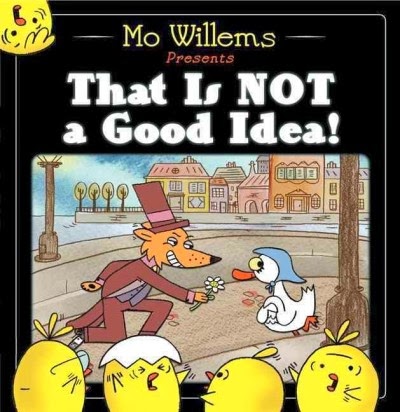
Mo Willems Has Yet Another Good Idea

Book:  That Is NOT a Good Idea!  by Mo Willems
Puppets:    Goose, Wolf (or Fox), Goslings (3-5)
Props:    Pot (big enough to fit Wolf puppet); Veggies (optional) Puppet Stage (optional)
Presenters:   2, plus 2-4 kids from audience
Audience:   Family Storytime (mostly 3-6 year olds)

Not all Mo Willems books are easily adaptable for presentation, but that doesn't mean we don't look carefully at every new one that comes along.  It took a bit of tinkering, but That Is Not a Good Idea! worked out very nicely when Sheila and I had "Mo Willems" as our Family Storytime theme last week.  In the book, Fox tempts Goose to accompany him, step by step, to the woods, to his kitchen, and into his soup pot.  Goose plays along and has a trick of her own at the end.  Meanwhile Goose's little Goslings act as a kind of a chorus:  Each time Goose agrees to one of Fox's sly suggestions, they yell out the title of the book.  The joke is that they're really warning Fox, not Goose, that things will end badly for him.

We used our puppet stage and regular hand puppets for Goose (maybe not technically a goose, but Sheila made this great bird puppet years ago and I use it every chance I get) and Wolf (we have a Fox puppet, but our Wolf is just a bit more expressive).  They appear on stage, Wolf makes a suggestion ("Shall we walk in the woods...?"), Goose agrees, then both exit. 

For the chorus of Goslings, we scanned, enlarged, and laminated the guys from the book, then stuck them onto paint sticks.  My original idea was that they would appear above the puppet stage, looking down on the other two.  Then Sheila had a better idea:  we had four kids from the audience come up to hold one Gosling each next to the stage, while Sheila held the first one.  This worked even better for their "chorus" role.  Sheila ran them through their line before we started, adding that they would say "really not..." then "really really not..." and so on.  She also encouraged the rest of the audience to join in on the refrain, and they did. 

We didn't bother with any backdrops; Wolf just said: "Now that we're in the deep dark woods..." and that was enough.  Each time the audience chimed in with the "..not a good idea" part, Wolf would pop back up and say something:  "you be quiet," or "it is too a good idea."  That's not in the book, but we felt like adding interaction between Wolf and Goslings helped establish the chorus' role and Wolf's plans.

When it's finally time for soup, Wolf puts a big plastic pot on the stage, adds a few vegetables to draw it out (and a lollipop just to be silly) and finally prepares to add the last ingredient, which everyone thinks will be Goose.  The Goslings give their last warning, then Goose grabs Wolf and stuffs him in the pot.  First, though, she explains that the Goslings "did try to warn Wolf..."   We wanted to make that clever twist very clear to everyone in the audience, short of spelling it out directly.  

Once Wolf is in the pot, Goose calls the Goslings down to have lunch with her.  The kids bring their stick figures over, Goose takes a bite or two of Wolf, and the kids, following Sheila's lead, have their Goslings gather round the pot for their own share.  Sometimes we find simple ways to soften the ending of a story that ends gruesomely, trying to respect the delicate nature of three and four year olds without compromising the story.....not this time.  We just followed the perfect ending of the book and that Wolf got eaten up.  The story was just so silly and so neatly constructed, it was by far the most satisfying way to end it (for the storytellers, as well as for the hungry geese). 


Wednesday, October 16, 2013

Fat Cat Tries to Sit on People (not puppets)

Book:  What Will Fat Cat Sit On?  by Jan Thomas
Puppets:  None
Props:   2 Signs each for Cows, Chickens, Pigs, Dogs, 1 each for Cat and Mouse
Presenters:   2, plus 4 child volunteers
Audience:  Family Storytime (mostly 3-6 years old)

I've enjoyed doing What Will Fat Cat Sit On? with puppets, and it was even my first post on this blog (January 17, 2011).  Terri and I decided to do it as an act-out for our "cats" themed Family Storytime.  In the story, Fat Cat half-threatens to sit on five different animals, so we decided to use kids for four of those, with Terri as Mouse, who comes in at the end.  Sometimes with stories like this we've had kids hold puppets or have something on their heads to identify the animals, but this time we just decided to have them hold a mask, laminated and mounted on a paint stick.  Some of the kids put the masks in front of their faces, some held them at their chest and either way works.  We had some store-bought farm animal masks for Cow + Chicken + Pig already that we'd used for a different story.  Then for Cat, Dog, and Mouse, we scanned, enlarged,

and laminated face pictures from the books.

Having the masks on sticks makes it real easy to switch, so we decided to have Terri and a child as each animal (except Mouse).  That way Terri could cue the kids and supply some of the personality, but it also gives the kids enough room to get into it too (and some did, some didn't).  I was thinking maybe I should stuff my shirt with a pillow to make a really fat cat, but Terri said don't worry about it:  curved arms, big wide steps, and a deep, goofy voice is all you need....and she was right, as usual.  
 
So first I come out as Fat Cat, wondering what I should sit on.  All four kids are sitting on small chairs, while Terri is behind the backdrop poking the Mouse mask out and back, which the kids see, but I don't, to sort of preview the Mouse ending (and parallel what Jan T. does with her illustrations).  Then Terri comes out, grabs a Cow mask and steps up with the Cow child as Fat Cat notices them and says:  "Will Fat Cat sit on...the cows?"  Then there's a short, slow chase as Fat Cat takes big steps towards the cows, circling them, until the cows say:  "Sit on the Chickens!"  The pattern continues with Chickens and Pigs, then shifts a bit when the Dogs growl and Fat Cat runs away.  

In the book, it's only the Chicken who tells Fat Cat to sit on someone else, but Terri had the good idea to do this for each animal, to really make the transition clear to the audience and to give the child volunteers a little more of an active role.   When Mouse comes out, Fat Cat repeats the big "What will Fat Cat sit on?" refrain, getting closer and closer to Mouse, who finally suggests the chair.  Each time we did this, when Fat Cat sits on the chair, the audience thought it was over, making the final twist ("Now....what will Fat Cat have....to EAT?!") even more fun.  Fat Cat gets off the chair and we have another slow chase as all the animals take off.  

To give it a nice clear conclusion, after chasing the animals I say one more "What will Fat Cat eat?" and pull a carrot out of my pocket.  Not in the book, but it worked just right for this presentation.  For two of our four performances we had a third teller, Carson Mischel (a visiting children's librarian from the nearby West Linn Public Library), and this story worked fine with three too.  Carson took the Mouse part, leaving Terri to do the other animals. 


Sunday, October 6, 2013

Dog's the Best

Book:  I'm the Best  by Lucy Cousins
Puppets:   Dog, Horse, Ladybug, Frog, Duck
Props:  None
Presenters:  two
Audience:  Family Storytime (mostly 3-6)

This Lucy Cousins story has a pretty simple structure and a character whose defining trait (self-centered, conceited) is fun to play around with.  Sheila and I did this using puppets.  We thought about doing it from behind the stage, but decided we needed to show the actions of the animals more broadly. So we were on stage with puppets on our hands.

Sheila was Dog, who thinks he's the best.  Following the book, we told it all in dialogue, so she had to show dogs conceit through her voice, but also lend a bit of silliness to it so he came off as more childish than mean. After his opening brag, each of the animals come out for a contest.  We switched a puppet or two to match what we have.  Actually we switched everyone but Ladybug.  But it works the same:   Dog has a contest with the animal, and outruns Frog, outswims Horse, outjumps Duck, and is just way bigger than Ladybug.  Those were all simple to act out with puppets, and easy for the kids to get what's happening.

Then after Dog has hurt everyone's feelings, they come back and have a different series of contests, playing to their strengths:  Duck outswims Dog, Frog outjumps him, etc.  Then, because Dog's sad, his friends cheer him up by reminding him that he's the best at being their friend.  If that had been the end of the book I would have been disappointed, but fortunately Dog finishes with one last brag about how his fluffy ears really do make him the best.  I mean, it's fine to have a positive message and all, and I do believe Dog really did learn something, but at a certain level, a dog that full of himself is just going to be that way no matter what. 

Sunday, September 29, 2013

A Pirate, A Parrot, and Vanilla Wafers

Book:  Pirate Pete  by Kim Kennedy; illustrated by Doug Kennedy
Puppets:  none
Props:   Treasure Map, Pirate Hat, Toothbrush;  Pot;  Potatoes; Pillow Case; Book; Chest; Vanilla Wafers
Presenters:  2, plus 3 child volunteers
Technology:  PowerPoint scans
Audience:  Family Storytime (mostly 3-6 year olds)

We present our Family Storytimes with two people, rotating combinations among four of us (Me, Brad, Sheila, and Terri).  Usually we develop stories together or sometimes tweak ones we've done before.  Last week I was a last minute fill-in for Brad, so I did "Pirate Stories" with Terri.  The two of them had everything all worked out, so all I had to do was step in...they'd already done the hard creative part of making the stories work. 

They've developed an especially neat way to present Pirate Pete, using props, kids, and scans.  I played Pete and Terri was Polly, his parrot.  We find a treasure map that says we'll find gold on Mermaid Island.  Pete's refrain is "Where there's a-gold, that's where I'm a goin'!"  So we get in our ship and sail, which gives a nice interlude where the kids get up and stretch:   We all put hands above our heads (like a sail) and move from side to side while singing this quick refrain:  
  "We sail and we sail and we Stop! / We sail and we sail and we Stop! / We sail and we sail and we sail and we sail and we sail and we sail and we Stop!"

Then we all take out our imaginary telescopes and look for Mermaid Island.  This is where the scans come in.  While Pete and Polly look out towards the audience, we click to make a telescope view appear.  The kids see the scan, but we don't, so we have some fun making it disappear when we turn around, then reappear, until finally we spot it.  But this isn't Mermaid Island, it's.....Candy Island!  Pete decides there might be gold there because:  "Where there's candy, there's kids; and where there's kids, there's teeth; and where there's teeth there's cavities; and where there's cavities there's....gold fillin's!"

Here's where the kid volunteers come in.  We look in the audience for gold fillings and find the child we gave a big toothbrush to earlier.  We bring her up and have her open her mouth.   But no fillings, of course, because she brushes her teeth with that toothbrush.  We take her toothbrush anyway (because that's what pirates do), and she sits down.

That pattern repeats twice more:  Back into the ship;  Sing the song;  Look for Mermaid Island;  Find other islands instead; Bring up a child with props.  For Clover Island the child has a pot...but inside is potatoes, not gold.  For Sleepy Island it's a pillow slip, but the treasure isn't gold dust, but a book (which we admit is a treasure, just not the treasure we're looking for). 

Finally we find Mermaid Island and read from the treasure map to find the treasure.  We go forward 5 paces, backward 8 paces, and wind up crashing into a chest that's been there the whole time, but covered with fabric.  We peek in, but don't let the kids see.  Then we pretend that there's nothing there, the story's over, and we sailed off to follow the gold in the sunset.  The kids, of course, don't buy it and really want to see what's inside.  So we reveal the gold doubloons:  Which are actually
Vanilla Wafers.  And when Storytime is over, we pass out one "piece of gold" to each child. 

The story really works well.  The song and stretch makes a perfect interlude, the kid volunteer piece is fun and purposeful, and the scans work well within the acting out and tie it strongly to the illustrations from the book.  And it worked out great for me:  Brad and Terri did all the creative stuff, and all I had to do was show up and talk like a pirate. 


Saturday, September 21, 2013

Brave Cowboy and His Lullaby


Book:  Let's Sing a Lullaby with the Brave Cowboy by Jan Thomas
Puppets:   Cow, Sheep, Wolf
Props:  Cowboy Hat, Flower, Pillow and/or Blanket
Presenters:  One (also works as a two-person act-out)
Audience:   Toddlers (1-2 years);  also works with Preschool

My Toddler Time group is for ones and twos and I try to choose material accordingly, but every once in a while I just have to try a story that’s more of a 2-3 year old choice.  Let’s Sing a Lullaby with the Brave Cowboy fits that description.  In the book, Brave Cowboy tries to sing the cows to sleep, but gets scared by things that aren’t really scary:  a flower that he thinks is a stick, for example.  For preschool kids, you can really play up the mock-scariness of the story, but everything for ones and twos has to be pretty gentle.

I put on a cowboy hat to play the role of Brave Cowboy, rather than using a separate puppet.  That way I can control the goofiness and make sure any suspense is always light-hearted.  I used one cow puppet, rather than the pair used in the book.


I sing the lullaby to the tune of “Home on the Range” (the “Oh give me a home…” verse part, not the “Home, home on the range…” part)Sheila and Terri worked that out when they did this story for older kids. I had to write it like this:  "It's time for little cows to rest their heads / It's time for little cows to-go-to-bed," with the dashes in the last bit so I remember to run those together and match the rhythm of the song.   
|
  The song ends with: “It’s time for little cows to say….” And then instead of a gentle “good night,” Cowboy says:  “OH NO!”  (It’s “EEEK!” in the book, but I’m not sure toddlers get “eek!” so I changed it).  Cow asks what’s wrong and Cowboy points to the puppet bag:  “I think I see a Huge Hairy Spider.”  As Cowboy, I reach in and poke out the top of the flower, so everyone can see it’s not a spider.  Then Cow pulls it out and reassures Cowboy.  Since it's toddlers, I don't act too scared at the suspected spider.  And I reveal the top of the flower for a bit before Cow identifies it for Cowboy.  That keeps the kids one step ahead of Cowboy, which is just right for the story.

The same sequence repeats:  Cowboy sings the song;  Thinks he sees a Large Lumbering Bear;  It’s really a Sheep.  The book also has a bit with a Snake / Stick, but I decided we only needed two Cowboy errors with toddlers, and then could go right into the last bit.

Now Cowboy realizes he’s been overreacting. But when he says that the next thing in the bag might look like a Huge Shaggy Wolf, Cow zips away behind the back.  Cowboy says it’s “probably just a Big Giant Bunny, right Cow?”  Cow sneaks back, looks and says “No, it’s really a Wolf.”  For preschoolers this is a fun, wild moment that you play up a lot, but with this crowd you keep a smile on your face and never have Cowboy be all that scared.|

The ending wraps it all up nicely, as Cowboy sings the song to Cow and Wolf and they finally make it to the closing line of “It’s time for us to say:  Goodnight.”  In the end, this one worked the way slightly-too-old-for-Toddlers books often do:  They enjoyed it, even though they might not have fully grasped the humor of a Cowboy who claims to be brave but really isn't.  But...there's a storyteller in a cowboy hat, some puppets doing silly things, and a nice little song, though, and you can't go wrong with all that.