Friday, November 11, 2011

Little Rooster's Magic Stomach

Story:  “The Little Rooster and the Turkish Sultan” from Twenty Tellable Tales by Margaret Read McDonald *
Puppets:   Rooster
Props:  Crown or similar for Sultan; Treasure chest (optional)
Presenters:   Three; Two works also
Audience:   K-2 (fine for preschool too)

Here’s a great story for oral telling, which I first learned from Margaret Read McDonald’s Twenty Tellable Tales.  For our K-2 Book Adventure on “Magic Tales and Tricks,” though, we acted it out with three people.  I was the Sultan, Sheila the Servant, and Terri was Rooster (using a puppet).  Terri narrated the Rooster parts and I narrated the Sultan parts:   Terri:  “One day a Rooster found a diamond button.  And he put it in his pocket."  Steven:  “A Turkish Sultan was walking by and he told his Servant:  ‘I want you to grab that Rooster and take away his diamond button.’”  Like that…

With three people, we could add some fun physical pieces that you don’t get as a solo teller.  When the Sultan tells the Servant to put the Rooster into the well, Sheila and Terri play aournd a bit as the Servant tries to grab the Rooster who zips just out of her reach a couple times.  When Sheila finally gets the puppet, she whips it off Terri’s hand and throws it into the audience (which for now is the well...later they are the fire and the beehive).  Then Terri recovers it and continues the story.... "the Little Rooster had a magic stomach…”   This pattern goes on as the Rooster uses his magic stomach to swallow all of the water from the well;  then empties the water to put out the fire;   and then swallows all of the bees in the hive.  Each segment has a mini-chase and a Rooster-toss.  Oh, and when the water comes out to douse the fire, I squirt the audience with a water bottle. 

We talked about ways to do the next part, where the Sultan sits on the Rooster and the bees come out.  Was there a way we could have the Rooster inside the pants?  First we’d need to find some suitable baggy pants, and we just didn't have any handy.  Maybe we could have worked it out, but we settled for Sultan just sitting upon Rooster, then getting stung.  I’ve always enjoyed Rooster’s final trick:  the audience thinks that once the Sultan gives up and the diamond button is returned, it’s all over, but Rooster uses his magic stomach to swallow up the Sultan’s treasure as well.   

We also used this story to promote our K-2 Book Adventure program at the schools.  We only had two people for this, so we dropped the Servant and had the Sultan do the grabbing and tossing of the Rooster.  We told it to the point where the Rooster has just put out the fire with the water from the well, and the Sultan gets his next idea, which is to “take that Rooster, and put him……well, if you want to find out where the Rooster goes next, come to the library for the whole story."  It never feels quite right to leave them hanging like that, but it does work as a hook…
* Other versions of this tale include:  The Valiant Red Rooster by Eric Kimmel, illustrated by Katya Arnold;  The Little Rooster and the Diamond Button by Celia Lottridge;  Little Rooster’s Diamond Button by Margaret Read McDonald, Illustrated by Will Terry

Saturday, November 5, 2011

Magic Chicken on stage and screen

Book:  The Wizard, the Fairy, and the Magic Chicken by Helen Lester, Illustrated by Lynn Munsinger
Presenters:  three
Props:  Moon wand, Wizard hat, Star wand, Fairy wings, Pickle wand, Chicken hat (or similar)
Technology:  Scans and PowerPoint
Audience:  K-2

For our K-2 Book Adventure theme of “Magic Tales and Tricks” we acted out one of my favorite picture books and also scanned some of the pictures to project on the screen.  We just used simple hats and wands to be the three title characters.  I was Wizard, Sheila was Fairy, and Terri was Magic Chicken.  Brad didn’t do this program, but it was his idea to use PowerPoint with this story, and he’d done a slightly different version for Storytime in the past.   

We each demonstrated what we could do, one at a time, stepping forward and pushing the others out of the way when it was our turn.  Then we’d cast our spell with a “Zip!” (Wizard), “Zap!” (Fairy), or “Zoop!” (Chicken), and the “magic” happens on the screen.  So when Wizard changes a pig into a bicycle, the pig shows on the screen, then it’s “Zip!” and the image is of flickering lightning, followed by a bicycle.  Munsinger’s illustrations are great, but for this part we used photos of the objects.  Sometimes it’s too hard to crop a single image out of a page when it’s not surrounded by white space.   The book has Wizard kiss a pig to make the magic, but that didn’t make sense with the images on the screen; just pointing the wand worked better.

After each character has done silly magic, they each create a monster.  For these we did use Munsinger’s illustrations…they weren’t perfectly croppable, but close enough.  I don’t like to distract from a story with a lot of PowerPoint effects, but I liked this one:  When the monsters all look at the magicians, we use the “emphasis: grow” effect, so they all get larger at once.  Then the three of us run around for a bit until we’re ready to try our magic.

Wizard makes a cloud, but it doesn’t stop his monster.  So that’s an image of the monster;  then a cloud appears above him;  then that “grow” effect again so he grows right over the cloud.  Same thing for Chicken and her monster and rain.  We didn’t have an image for Fairy’s thunder so we just had the kids all stomp.  When the three friends finally all worked together, the cloud and rain images reappeared, plus Brad had added a cool (and loud) thunder sound effect. 

Using another PowerPoint effect, we showed all the monsters full size, then shrank them:  that’s just copying five or six identical images, each one smaller than the next, stacked on top of each other.  Then you use the “exit: dissolve” effect and click really fast, so the bigger sizes disappear one by one.  Three tiny monsters are left and you have them each do a “motion path” that you draw in a bunch of squiggly, spirally lines, so it looks like they’re running crazily over the screen.  

This act-out/PowerPoint combo worked very well.  As the three characters, we could play around and show enough personality so the focus was really on us.  And the screen let us show the magic happening, but not to the point where it was distracting.  More posts on the “Magic Tales and Tricks” program will come soon…. 

Monday, October 31, 2011

Chipmunk & Bear

Book:  How Chipmunk Got His Stripes by Joseph Bruchac, Illustrated by Jose Aruego & Ariane Dewey
Puppets:  Bear, Chipmunk, (plus a second Chipmunk if you’ve got one)
Props:  Safety pins
Presenters:  2 or 1
Audience:  Family Storytime
Terri and I told this one with puppets during Family Storytime.  I’ve done this solo, but it works even better with two.  Chipmunk has no stripes when the story starts (he’s called Brown Squirrel), so we folded the puppet’s stripe in and safety pinned it.  We considered acting it out or using the puppet stage, but felt it worked best with us just holding the puppets.  We could have used audience volunteers for other animals or props and/or lighting to show the sunset and sunrise, but we really liked its  strength as an oral tale so we decided against any extras.  Terri switched between narration and Chipmunk; I was Bear.      

In the story, Bear brags that he can do anything.  Bruchac has an excellent storyteller’s refrain:  “I am Bear, I am the strongest…I can do anything…hummph!”  This is fun to do with a puppet, swinging Bear a bit to give him a swagger, and really punching the “hummph!” each time to convey his personality.  Terri used a high voice for Brown Squirrel and added a little “Wheee!” each time he finished a verse, which was just right.  The clearly contrasting personalities make it easy and fun for the kids to follow.  When Bear makes the sun go down, we just all looked over to the west of the room, then turned to the east side of the room to wait for it to come up.  Which Bear is sure won’t happen:  “The sun will not come up….hummph!”  But Brown Squirrel knows it will “The sun will come up….wheee!” 

Terri and I are sitting on a bench with our puppets at this point.  When Brown Squirrel teases Bear too much, we have a little chase.  We made sure to slow it down and not make it too wild.  Bear takes two good leaps at Brown Squirrel, missing both times.  Then as Brown Squirrel ducks behind the backdrop (his hole), Bear gets him with a good scratch.  While Bear tells the audience that he almost got Brown Squirrel, Terri is behind the backdrop taking out those three safety pins as fast as possible.  Bear goes off to the opposite side and Brown Squirrel returns, now with stripes showing, and explains that he is now “Chipmunk, the striped one,” who’s always up early.  Bear returns to explain that he sleeps late, to avoid Chipmunk’s noise, and to forget the timed he learned the lesson that “nobody can do everything.”  

This is one of those folktales that’s just right for the 3-5 year old crowd (and older kids as well).  Two distinct characters, humor that they get, and an explanation at the end that really makes sense.  It’s a good one-person puppet story as well, though you can’t have quite as much fun with the chase.  The safety pins are a bit harder to manage solo as well.  I actually have two identical chipmunks, so can just trade out for the second unpinned one.
 

Sunday, October 23, 2011

Snake and a Bottle


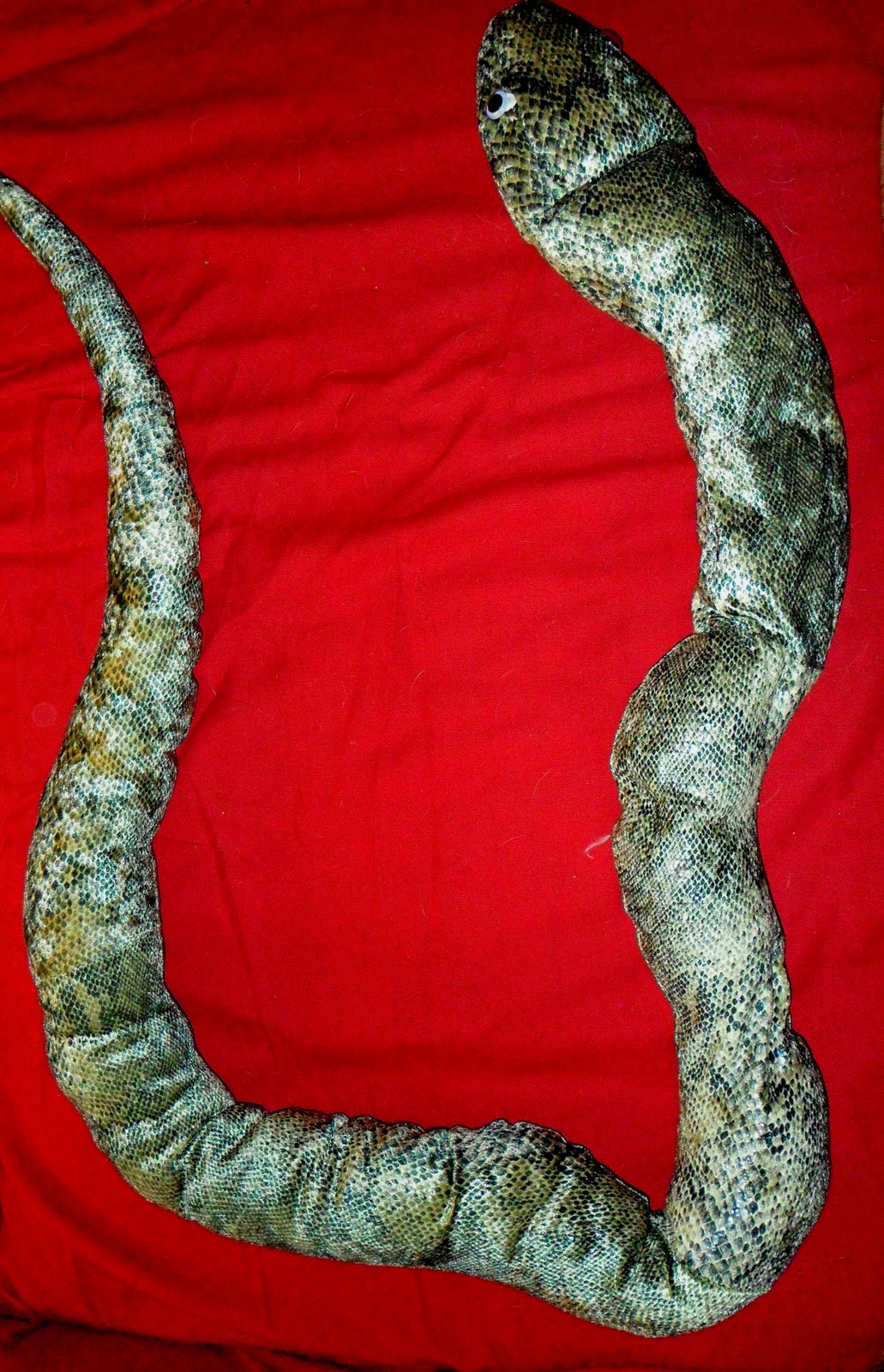
Book: Crictor  by Tomi UngererPuppet:   Snake
Props:   Long box, baby bottle, pacifier, scarf, leash, police hat, medal
Presenters: One or Two
Audience: Family Storytime


Crictor was a favorite book of mine (and of my mom) when I was a kid.  I even had a big stuffed snake that I named “Crictor.”  I think I got it when I was ten and supposedly too old for such things but I think because it was a snake, rather than a bunny for instance, it was okay.  That snake is either gone or in a box somewhere in my garage, and if it is there it must look pretty ragged.  But I do have a cool boa constrictor snake puppet and some props to go with it.  Terri and I acted out the story for Family Storytime, with me narrating and her as Madame Bodot. 


We stuffed Crictor into a long cardboard box (used for butcher paper rolls) and Terri slowly pulled him out, little by little, tail first, to start the story (in the book he comes in a round box, and when I first saw this story told by Bonnie Janssen of Alameda County Library, she had a box just like it!).  We demonstrated several, but not all, of the ways Madame Bodot interacts with Crictor in the book, and each one was fun for the kids.  Feeding him with a baby bottle is very funny.  We added a binky and a burp.  Terri dressed him in a very long scarf.   Then hooked a leash on his neck and bounced him along for a walk. 

When Madame Bodot uses Crictor to teach her students, Terri addressed the audience as if they were the school children and asked them to identify the letters while I formed the snake into them.  A stuffed or puppet snake isn’t as manageable as a drawn one, so we stuck to the simplest figures:  O, L, and U (squiggly, but close enough). 1, 0, and 7.  For the playground scene, we had a child come up and “jump rope” using Crictor (which for a preschooler means the snake is still on the floor while she jumps over it).  Crictor as a slide doesn't work with the puppet, so we pass on that one.

We toned down the climax, where Crictor captures a home-invading robber.  Instead we just had Madame Bodot walking home with the snake, while I came up from behind as if to steal her purse.  Crictor promptly wraps himself around me and we had a child pre-coached with a police hat to come and haul me away.  Crictor, of course is awarded a medal and lives a long and happy life. 

I liked the way the story is gentle and clever and unusual, and it all holds together so well.  There’s something very casual about the presentation that we sometimes don’t get in our efforts to be wildly entertaining.  I mean, it’s still entertaining, just in a different way.   And Tomi Ungerer’s words and pictures are always worth sharing with kids.  In fact, as much as I love it, Crictor is only my second favorite Ungerer…now I just have to think of a way to do The Three Robbers. 

[* * * Blog error note:   Apologies to anyone who checks this blog looking for storytime stuff and occasionally finds a soul music video link, like earlier this week.  Just to clarify, we most definitely did not perform “Function at the Junction” by Shorty Long during Family Storytime.  That’s my other blog, a countdown of the top 1,000 soul songs of the 60’s and 70’s, and when I post a new video I sometimes embed it into the wrong blog by mistake.  Probably one of these days I’ll do the opposite and Mo Willems will wind up on that countdown in between Aretha Franklin and Otis Redding….]

Sunday, October 16, 2011

K-2 Book Adventure Program Summary: Cats and Dogs

K-2 Book Adventure Program Summary:  Cats and Dogs 

Our first K-2 Book Adventure of the school year was on “Cats and Dogs.”  So we picked out some cat stories, some dog stories, and one that featured both. 

Along with the stories, we did a recurring “Cats vs. Dogs” feature.  This is where Sheila (as a dog) and Terri (as a cat) face off with different types of cat and dog books.  So we
started with a “Poetry Slam.”  They each read a poem for their animal from Douglas Florian’s Bow Wow Meow Meow.  And each did a concrete poem (with the image projected on the
screen) from Betsy Franco’s books:  A Curious Collection of Cats and A Dazzling Display of Dogs.  One thing I really like about this program:  It gives us a chance to promote poetry almost every time. 

Then we did our first story, an act-out of Officer Buckle and Gloria which also used projected illustrations.  (Details here).

Our next “Cats vs. Dogs” was “Fascinating Facts.”  They shared a bunch of amazing facts, using Cats and Dogs by Steve Jenkins and Cats vs. Dogs by Elizabeth Carney. 

The “Bad Kitty” books by Nick Bruel are fun early chapter books.  We scanned several illustrations and used them to help tell a few scenes from the Bad Kitty Meets the Baby:   When Kitty meets the dog;  When Kitty meets the baby;  and a bit from the “Kitty Olympics.”  The visuals on the screen along with the humor of the story really gave the kids a good feel for what those books are like. 

To balance the Cat/Dog theme, we took a similar approach with Down Girl and Sit.  This time we just used a couple scans and had “Ruff” (the man) explain to the kids why his dog is called “Down Girl” and the neighbor dog is called “Sit.” 

Another “Cats vs. Dogs” interlude:  this time on Jokes and Riddles.  Dog and Cat each did a few riddles, culled from a few books because it’s actually hard to find really good riddles.  And we projected illustrations from the books at the same time.

Then it was Pete the Cat, told with three people.  Details are here.  For a stretch break, we extended this story by having the kids stand up and calling out other stuff for Pete to step in.  Then acting it out while reprising the song.  I was surprised that no one picked the first thing that came to my mind (hint:  it’s brown), but I guess maybe 6 and 7 year olds are more polite than me. 

Our last Cats vs. Dogs segment was “True Stories.”  Terri did a quick booktalk for The Bravest Cat by Laura Driscoll.  Then Sheila finished up with Two Bobbies by Kirby Larson.  A nice one to finish with since the it’s really about a dog and a cat who work together.  Although we then finished with an enemies tale…

Our final story was an act-out of Why Dogs Chase Cats, which we’ve done before for Storytime (see here).  This was also the story we used for the K-2 Previews we do at our two Primary Schools.  We acted it out just to the part where you realize that Cat thinks it’s “my ham,” not “our ham,” then told the kids to come to the library to see what happens.  And lots of them did.  

Sunday, October 9, 2011

Mr. Bear, Danny, and a bunch of farm animals

Book: Ask Mr. Bear by Marjorie Flack
Puppets: Bear, Duck, Sheep, Chicken, Cow
Props: Pillow, Blanket, Egg, Milk
Presenters: One
Audience: Toddler (1s and 2s) or Preschool
Link to Youtube Video Demo

This is one of those classic (69 years old!) picture books that adapts very neatly to tell with puppets in different ways. My favorite way is to just tell the story with most of Marjorie Flack’s words plus some participation from the kids, with me as narrator and as Danny. So Danny sets off to get ideas for his mother “and he met….who did he meet?...[out pops Duck]: Mrs. Duck!....“What does a duck say?” [kids quack]. Then switching from narrator to Danny, it’s: “’Mrs. Duck,’ said Danny, ‘can you give me something for my mother’s birthday?” Duck pulls up a pillow from the bag, and Danny politely thanks her, but his mother already has a pillow.

There’s a nice gentle rhythm to the story’s pattern, and telling it slowly and softly is the way to go, even with toddlers when there’s sometimes a finite limit to their attention spans. After a few animal/present sequences (cow/milk, chicken/egg, sheep/blanket) the pattern shifts when you give an unexpected pause and your voice gets a little quieter as Danny contemplates going to see Mr. Bear. Of course Mr. Bear isn’t scary at all, but he’s different enough from the farm animals that it adds just the right amount of Toddler-level suspense.

Once Danny gets home to Mother and everyone’s waiting to see what present he’ll give her, the story neatly prolongs the suspense a bit more as Mother tries to guess. I just tell this dialogue, without a Danny or Mother puppet, and pull out the pillow, blanket, and other props again as she guesses (so when they first appear I have to remember to keep them handy). You can just see those two-year-old brains working as they recall and anticipate the gift ideas: narrative skills at work! The bear hug that ends the story is me hugging bear and, if it’s been told right, all of the grown-ups in the audience hugging their kids.

I do make a few small changes from the book in order to tell it fluidly with puppets. In the book, each animal follows Danny as he goes to ask the next one, but I drop that bit to keep it manageable. The book uses nice language variation during Danny’s travels (trot, skip, etc.), but I choose to drop that and stick with the barest bones of the language. And four farm animals, or even three, works well with toddler ages, rather than the five in the book.

And I have tried it different ways with puppets. Having a Danny and a Mother puppet is workable, but for me it adds more puppet handling without enhancing the story. Also I like the way that young children so readily accept the fact that not every character needs to be represented by a puppet…it puts the story a bit more into the realm of “storytelling” than “puppet show,” and that feels right for this book.


Saturday, October 1, 2011

Officer Buckle, Gloria, and a Few Scans

Book:  Officer Buckle and Gloria  by Peggy Rathman
Puppets:  None
Props:   Dog ears or similar; Police hat and badge or similar;  Pile of papers (safety rules, but they can also hide a script)
Presenters:   Three (though two could work)
Technology:   Projector and scanned illustrations
Audience:  K through 2nd grade

Sheila had the great idea to act out this book as part of our K-2 Book Adventure “Dogs and Cats” theme.  It’s one of my all-time favorite picture books, but not a preschool storytime book really, so I don’t get to use it often.  We used three people to tell it, but I think two could work it out.  In our version, I narrated, Terri was Officer Buckle, and Sheila was Rosie the Dog.  We adapted the text  to just the essential bits and projected selected illustrations from the book, mostly towards the beginning and ending.  For example, when Terri read off a boring list of safety rules, we showed the illustration from the book with the bored, sleeping kids.  When Officer B. gets Rosie, though, the focus is more on the characters, so no slides for a bit. 

The safety presentations work just like the book.  Terri says a rule as Officer B. (“Never leave a thumbtack where you might sit on it!”), then Sheila, sitting behind Terri as Rosie, jumps up as if she just sat on a tack.  And the kids in our audience respond just the way the kids in the book, do, laughing at Rosie while realizing that Officer B. doesn’t know what she’s doing.  Sheila gives a little “woof” each time she’s sitting again, to signal Terri that she can look behind at Rosie again.  We did several of these and each one got funnier.  It’s that puppet show effect where puppet A does stuff, puppet B doesn’t see, then as soon as puppet B looks, puppet A stops.  The timing is trickier with two real people, but they pulled it off just right.  And of course the anticipation builds each time as the kids wonder what Rosie is going to do next. 

When Officer Buckle and Rosie watch themselves on tv, the Sheila and Terri sit down and look up at our screen, where we projected the illustration from the book where Officer Buckle learns the truth.  I liked the way our projection screen actually became Officer B’s television for that bit. 

We didn’t dramatize the disastrous accident at school (after Gloria and Officer Buckle stop doing shows together)…for that we showed the two page spread from the book on the screen.  The conclusion, where dog and safety officer are reunited, worked well:  Terri and Sheila get back together on stage, while the last illustration of the book goes up on the screen, along with the last safety rule:  “Always stick with your buddy.”  I’ll post a of our whole K-2 Book Adventure – “Dogs and Cats” program soon.

* a note about the dog ears:  We had regular dog ears available like the pair shown, but Sheila would not accept these: she insisted on making some more German Shepherd-y ones, which turned out very nice…I just forgot to get a photo.