Tuesday, February 28, 2012

Brown Bear Follow Up

Book:  Brown Bear, Brown Bear, What Do You See?   by Bill Martin Jr., Illustrated by Eric Carle
Props:   None
Puppets:   5 or more animals
Presenters:   1
Audience:   Toddlers, Preschool, Adults

I know everyone who does storytimes knows this book and has probably used it in a variety of ways.  Kids always seem to enjoy it, even when they know it by heart, but I’m mentioning it here because it’s my first choice to show both parents and library staff how easy it can be to use puppets.  I often hear from other children’s staff that they’re just not comfortable using puppets.  Most common reasons include:   Motions:  “I’m not comfortable holding and moving them;”  Voices:  “I don’t do silly voices;”   Puppet Management:  “Too much stuff to keep track of;”   Puppet Supplies “I don’t have good (or any) puppets.”  All of those are good reasons, and of course there are so many ways to bring stories to life without puppets….but Brown Bear is a great example of book you can use with puppets even if all of the above are true. 

I usually use puppets as a “Follow-Up” to Brown Bear.  So I’ll read the book, and then follow-up by saying….”you know, I have a Brown Bear (or a Green Frog…or a Gray Armadillo…) in my bag.  I wonder what animals he sees?”  So I pop-out Brown Bear and we all say “Brown Bear, Brown Bear, what do you see?”  And I reach into the bag and pull out…….….(those dots represent that hesitation you stick in there that always draw all eyes to your bag)…..And pull out a Green Frog (or whatever).  You can let the kids name the color and the animal or give them half of it (“I see a Green [I say]……..Frog! [they say] looking at me.”)   Then it’s “Green Frog, Green Frog, what do you see…” and so on. 

Very simple to pull this one off, even if you’ve never touched a puppet and are anxious about the stuff mentioned above.

Motions:  Motions are simple and repeated:  all you do is pop out the puppet…it looks at you or the kids, then looks into the bag at the next guy who’s about to pop-out.  The one trick is that when Brown Bear is done, you take him off your hand and put him somewhere else (lap, second bag or box), so that hand is now free to pick up the next animal.

Voices:  No need to vary voices at all.  You can, and it’s fun to make that Mouse sound different than the Alligator, but it works fine if you don’t worry about that.

Puppet Management:  With this story, it doesn’t even matter it what order the puppets appear.  You can just stick your hand in there and be as surprised as the kids. 


Puppet Supplies:   Really, any animals will do.  I’ve done it where I repeat the animals from the book (I finally found a blue horse at Goodwill!) or I’ve done it with all new animals (“Let’s what other animals see each other”).  And doing a mixture of book and non-book animals is fine too.  With this story, you don’t even need puppets…stuffed animals work just as well, since the motions are so basic.

So the basic story is easy.  And flexible.  You can repeat the book and use a whole new set of animals.  You can read one of the others in the series and Follow-Up with puppets.  You can extend it to a certain kind of animal:  “Remember that Brown Bear book?  Let’s try that with….birds!”  Doing this a few times in a few ways can really help someone who’s new to puppetry get comfortable and confident….and ready to try more stuff.

And then there’s the Parent/Caregiver angle.  When we read books in storytime we’re modeling for the grown-ups and sometimes adding tips and information to help them do the same.  That doesn’t often work so well with puppets, since most parents won’t have time/puppets/techniques to do what we do.  But after doing Brown Bear with puppets as a Follow-Up I always point out that this is something they can do at home pretty easily, with puppets, stuffed animals, hard animals, even pictures.  They can even have their kids tell the story that way. 

And in both cases, it’s a great way to play with Narrative Skills that are such an important part of early literacy learning.  Retelling a story you’ve heard is a basic Narrative Skill, and with Brown Bear, the puppets (or similar) actually serve as visual cues to help a child tell the story.  It’s also excellent for building Vocabulary, as kids supply the words to identify the names and colors….and you can make it more complex too, adding animals with two colors (Zebra) or more.


Monday, February 20, 2012

Raven with puppet and people

Book:  Raven: A Trickster Tale from the Pacific Northwest  by Gerald McDermott
Puppets:   Raven, Child (we used a doll, not a puppet)
Props:   Box, Sun (ball covered in yellow), Pine Needles, Basket
Presenters:   Three;  Works with 2 also (Narrator as Raven)
Audience:   K-2

For our “K-2 Book Adventure” on Tricksters, we just had to include one from Gerald McDermott’s series of folktales and chose Raven, one of my favorites (plus it's from our part of the world).  We wanted to retain the fairly formal mood of McDermott’s telling, but at the same time capture the playfulness that’s also in the book.  I narrated and played Sky Chief, Terri had the Raven puppet, and Sheila was Sky Chief’s daughter.  I have a more realistic puppet for Raven, but we opted for the goofy puppet with big eyes and an orange beak (neither of which real ravens have, but we’re storytellers, not ornithologists).   

As Sky Chief, I hold up the ball of light (just a ball wrapped in yellow tissue paper), then hide it away into a box at the beginning.  Raven flies around until he spots the light.  When he spots Sky Chief’s Daughter, Raven does the old turn-into-a-pine-needle-get-swallowed-and-come-out-as-a-baby trick.  Which for us was Terri going behind a backdrop, taking off Raven puppet, and dropping a sprig of pine needles into Daughter’s basket.  Then it’s Daughter going behind the backdrop and emerging with a black haired doll we have that actually looks pretty Raven-esque. 

To this point the narration follows the book fairly closely, and the characters follow the actions of the story without doing much more.  But now comes the playful part, where Terri holds Raven-child and tries to get at the box which holds the light while Daughter tries to prevent him from getting to it.  Sheila and Terri had some fun with the humor:  lots of movement, near collisions, and sneakiness, plus the dialog of Daughter’s increasingly irritated pleas to her child and Raven-child’s whining and cawing.  I like the way this bit of silly action is bookended by the more formal opening and the meaningful ending. 

Raven-child finally gets by Daughter and grabs the light from the box.  We initially included the box-within-a-box-within-a-box segment, which works nicely in the box, but it turned out to interrupt the flow in this act-out version, so we dropped it.   Once Raven-child gets the ball of light, Terri ducks behind the backdrop one more time, drops the doll, gets Raven puppet back, and, after a bit more chasing, puts the light high up into the sky for everyone to enjoy.  Which in our version is:  hands the ball of light to me, I step up on a stool, and hold it high over my head…and that works. 

This was one of those stories where we considered some extra stuff we could do with props, but ended up doing none of them: Use an actual glowing light for the sun! Turn off lights and closing drapes for darkness!   Attach ball to fishing line and have it mysteriously rise to the ceiling!  We did none of these and  instead we kept things simple and trusted the story and the kids’ imaginations, which is almost always a good way to go….    

Monday, February 13, 2012

The Little Engine That Dolly Likes

Book:  The Little Engine That Could  by Watty Piper
Puppets:  None
Props:   Wooden cart with wheels (or something to be a train); Train Whistles;  Smokestacks hats (colored paper cylinders or similar); a Pillow for the knees of the poor guy in the cart; Conductor's Hat (or similar to wave)
Presenters:   3 (or 2) plus several kids from the audience 
Audience:   0-5

It's a favorite for many people and a classic picture book and all, but I have to admit, The Little Engine That Could was never really my kind of story.  I have a vague memory of some elementary school teacher reading it with a bit too much enthusiasm…I guess even then I had my preferences about storytelling styles.  This month, however, I was glad to give it a try, because our library just started a cool program called Dolly Parton’s Imagination Library.  Every child under five within city limits can sign up and get one free book every month up to their fifth birthday!  More details about the program are here, but the key piece of information for this blog entry is:  Dolly Parton’s favorite book is.......The Little Engine That Could!  So it's the first book every participating child receives, and for our kick-off event we gave out copies to all who attended…and of course we had to present the story.

Luckily, Brad and Sheila had come up with a fun way to act out this story a few months ago for a “trains” themed storytime.  Adapting their approach just a little, Terri, Sheila and I acted it out for the 150 people who attended the kick off event.  With a rainbow wig, clown hat, and red nose, I was the Clown in the stranded “train,” which was a rolling wooden cart that I barely fit into.  Terri and Sheila started out as the engine that abandons the Clown and all the toys and books for the kids on the other side of the mountain.  Each wore a colored smoke stack: a rolled up cylinder of butcher paper with white tissue hanging down for smoke. They pulled me from the back of the room to the front to start the story, going along “train tracks” we had taped on the floor.  I held a rope and they pulled and we blew our wooden train whistles.  When they gave up, they chugged off and I asked the kids to help me flag down the next train that came along.  Each child had received an engineer’s hat for attending, so we all waved them in the air and said “Stop, Train, Stop!” 

That set off the pattern, and Sheila reappeared, now with a Red smokestack, as the passenger train.  As she entered, blowing the train whistle, she plucked a couple kids from the audience to be part of her train.  After she departed, the audience and I flagged down the next train:  Terri, now with a Black smokestack, train whistle, and a couple more kids.  Terri and Sheila of course gave each of their trains plenty of personality.  Terri posed and flexed and tried to get her kids to do the same as the tough black train.  Then it was Sheila as the old train (chugging in slowly, leaning on a cane).  At last, both returned with Blue smokestacks as the good old Little Engine that finally could.  The kids all joined in with the “I think I cans” and the train rolled on over the mountain.  

Our audience was large, and mostly on the younger side of the 0-5 age range, so I was pleasantly surprised with how much they enjoyed this story.  Even as young as 2 or 3, they have no problem seeing a grown up wearing a goofy hat and blowing a whistle as a train in a story.  We had plans for making or drawing a mountain but ran out of time….and it didn’t matter, they totally got it.  And they really really wanted one of those trains to stop and get that clown and all of those toys (and books!) over the mountain.  The concept and tension of the story came through strongly with a big, young audience, and not that many books can do that.  So The Little Engine definitely moves up several notches in my picture book rankings.

After it was over, a few of the grown ups wondered why we chose to put the heaviest, tallest of the trio (me) in the rolling cart when it looked like I could barely fit inside the cart and was kind of hard to pull….and the answer of course is:  because it looked like I could barely fit and was kind of hard to pull.  Which adds just a bit more silliness. 

Sunday, February 5, 2012

Anansi and the Electronic Shadow Puppets

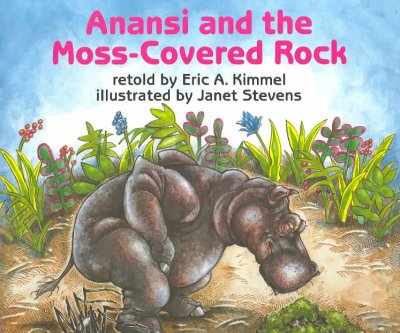
Book:  Anansi and the Moss-Covered Rock  by Eric Kimmel, Illustrated by Janet Stevens
Puppets:   None
Props:   Slide whistle (or similar sound effect)
Technology:   PowerPoint / Projector
Presenters:   One or two
Audience:   K-2
Link to "Storytelling with Puppets" video

Our January "K-2 Book Adventure" program was "Trickster Tales," so we had to include an Anansi tale, and this is one of the best for storytelling.  The thing is, I've done it a lot, in various ways (puppets with and without stage, act out, read aloud) and wanted to try something new.  I decided it would make a good shadow puppet story...if only I had shadow puppet stuff or any experience using them, which I don't.  But when you think about it, the white screen of a projector looks kind of like a shadow puppet screen.  And with PowerPoint you can find shapes to project on the screen and make them move around.  So I went ahead and took an ancient artistic tradition of shadow puppetry and slapped it into a laptop...I hope the puppetry gods will understand...
You can view the PowerPoint for a short time (through February 8) at this link through Feb 20th (you can share presentations for free at SendThisFile, but just for three days).  If you can't see it and want a new link email me at sengelfried@yahoo.com.
I did some Google Images searching to find silhouettes.  (to find the source for each one, right click on the image and enter "o" for open).  Then I set them up on PowerPoint as simply as possible.  I used "animation effects," either arcs or straight lines, to have the animals move.  I set the speed up pretty slow for each one.  It looks a little stilted as they move, but that kind of matches the shadow puppet effect.  When each animal sees the rock and says the words that put them to sleep ("what a strange looking moss-covered rock"), they do a "spin"  (another animation effect) and then lie down on their back (the right-side-up image "disappears" while an upside-down one "appears" at the same time).  We added our one and only sound effect here:  a slide whistle as they do their spin and fall. 
Most of the animation effects were repeated through the pattern of the story.  The rock puts Anansi to sleep.  Then he tricks Elephant, then Giraffe.  With each of these I narrated the conversations between Anansi and the other one.  Then Deer makes a quick appearance above, watching Anansi though he doesn't know it.  Lion and Crocodile come next, but without conversations, just "Anansi tricked more of his friends" as the same actionss of entrance, spinning, and sleeping repeats.  The story ends, most satisfyingly with the trickster getting tricked with his own magic rock by Deer.   

When I tell this tale with puppets or people, it's fun to play around with voices and peronalities, and it's great for audience participation.  With "shadows," though, we stripped it down to the core of the story.   I told it more as a narrator, without flourishes...the tale is strong enough to work well that way too, and it seemed to fit this type of presentation better.  Same with the images:  we could have shown the food that each animal eats or added houses or trees for the jungle, but kept up with a minimalist approach.  

This was a different sort of presentation for our K-2 events, sandwiched between dancing bunnies and musical opossums and other more lively spectacles.  I'm not sure if we really achieved the shadow puppet experience I was shooting for, but I liked the change of pace and introducing the kids to different styles of storytelling.  If I do it again, I might like to explore adding some music, or maybe more sound effects, but overall I thought it was a worthwhile approach to a story that you really can't miss with.


I  http://www.fun-with-pictures.com/image-files/fawn-silhouette.jpg

Saturday, January 28, 2012

K-2 Book Adventure Program Summary: “Food in Fact and Fiction”

Our December K-2 program was built around food.  As usual, we tried to mix in different types of books:  folktales, picture books, early readers, and non-fiction. 
We started with “Cookies,” from Frog and Toad Together, which is described here. 
Then we did the first of our
three “Funny Food” segments that we interspersed throughout the program.  These all featured scans of the amazing photos from the books of Saxton Freymann...you know, the ones where he makes fruits and vegetables look like stuff.  We selected pages from several of his books and grouped them into three categories:  Animals, People, and Vehicles.  Then we projected the series of images with music in the background for about 90 seconds each segment.  The music we chose was Scott Joplin's “The Entertainer” by Marvin Hamlisch (from the soundtrack to The Sting) for People;  “In the Mood” by the Henhouse Five plus Too (aka Ray Stevens and others "clucking" the song) for Animals;  and “Soul Limbo” by Booker T & the MG’s for Vehicles.  This was great fun for the kids (and fun to put together in PowerPoint) and gave a nice continuity to the program.  Plus there's the added virtue of exposing a bunch of 6 and 7 year olds to Booker T & the MG's.

Next up was Lunch Lady and the Cyborg Substitute by Jarrett Krosoczka.  Graphic novels are popular with this young age group, and easy to present.  Give them the premise (the Lunch Lady is actually a crime fighter!  The substitute teacher is an evil cyborg) and show some of the paneled illustrations on the screen and they’re hooked.

For a non-fiction food title we featured What You Never Knew About Fingers, Forks and Chopsticks by Patricia Lauber and John Manders.  This is a funny and factual look at how humans have eaten from prehistoric times to the present.  We shared a few facts from the book, accompanied by scans of Manders’ funny cartoon illustrations. 

Next up was The Fat Cat, which is described in more detail here.  We followed that with a food break.  We haven’t used snacks with this program in the past, but our theme pretty much required it this time.  We went with all fruits and veggies, cut up and put into cups, and the kids ate them all!  To serve them we borrowed a strategy we’ve been using in our “Cookies and Books” booktalk program for grades 3-5:  We give the kids 60 seconds to get up, get their food, and sit again, and we do a music/video countdown on the screen (from Minute to Win It) so they can see where they are.  It makes it fun, gets it done fast, and also serves as a “stand up and move around” break.

We did one more non-fiction book:  What Do You Do When Someone Wants to Eat You by Steve Jenkins, whose books I feature at any opportunity I get.  For this one we showed the picture of one animal on the screen (like the lizard) and asked the kids to guess how it avoids being eaten (tail falls off).  They seemed to know most of the answers, but that’s fine. 

We finished the program with If You Give a Dog a Donut.  Details are here.  Also, you can always click on “Program Summaries” under the “Labels” section on the right to see past K-2 Book Adventure line-ups.    

Tuesday, January 24, 2012

Frog and Toad and Imaginary Cookies

Story:  “Cookies” from Frog and Toad Together
Puppets:   Frog, Toad  (or none if acted out with two)
Props:   none
Presenters:   one  (or two if acted out)
Audience:   K-2 (but also good for Preschool)
Link to Youtube video demo

I’m pretty sure this is the first story I ever did with puppets.  The Friends of the Pleasanton (CA) Library had just bought a bunch of Folkmanis puppets for the Children’s Department in 1988.  At the time, Folkmanis just had one Frog hand puppet, so we bought two of those, thinking of Lobel’s stories.  About that time I happened to listen to Lobel himself narrating the stories on a book on tape, and he did it so well.  The combination of hearing that narration and having brand new puppets that were cute and all, but nobody had really used them yet led me to try this story.

I had no experience with puppets, but at least realized two key things that have served me well ever since.  If you say “this one’s a frog and this one’s a toad,” even when they’re obviously identical, kids will accept it and just let you tell the story.  I’ve used that “close enough” philosophy with puppet choices ever since.  Along the same lines, but different was:  “just because the story is all about cookies and cookies are in every single scene, that doesn’t mean you have to actually have any cookies.”  I was so focused on the characters and so uneasy about having anything but those two puppets to deal with, I just pretended about the cookies, and it worked...and I’ve been doing it that way ever since. 

I keep most of the dialog from Lobel to tell this story, though usually I have the characters self-narrate.  So instead of “Frog got a ladder” it’s:  “I will get a ladder” while Frog does that motion.  Depending on the audience, I might have Toad do some interaction with the kids as he bakes the cookies:  “What should I put in?”  As he carries them to Frog, you just march him with his hands positioned as if he’s carrying a plate.  The two friends eat the cookies with much enthusiasm:  I have them leap onto the (imagined) plate with loud, froggish “Yum, yum, yum” sounds. 

When Frog tries his tricks to prevent them from eating them all, it’s more acting out the motions.  He puts them in a box: Lift the “plate,” and set it down.  He ties the box up with a string:  Pretend to wrap a string around the “box,” right to left and front to back; then have him pretend to tie a knot on top.  The ladder?:  have Frog “climb” the pretend ladder, tilting the puppet back and forth as he goes up.  It might sound tricky, but if you practice this out a bit, you’ll see it’s not that hard.  Toad, of course, repeats these motions as he demonstrates why they won’t really work.  Toad’s sections all end with “…and eat all of the cookies!” which means a repeat of the leaping-onto-the-plate motion.

Two keys to all of this acting out:  First is to make sure you do the motions slowly.  For one thing, it’s easier, plus it gives the kids a chance to register and identify what the character is doing.  Second is to narrate as you do the motions.  Just doing motions of tying string around the box might not be clear to the kids, but when you say “I am going to get some string and tie it around the box” while you do the motions, it comes together.

Once you get the motions down, you’re free to have fun with the characters, which is really what it’s all about, and don’t have to worry about prop handling.  I’ve never once dropped a cookie or got my string tangled up doing it this way. 

This is also a fine story for acting out with two people, as Terri and I did for our recent K-2 Book Adventure program called “Food in Fact and Fiction.”  We pretty much followed the puppets approach, making all of our props pretend ones.  One touch we added, which I had never tried with puppets, was having the audience be the birds at the end.  Unrehearsed, they all immediately started tweeting and flapping, then pretended to eat the cookies that we pretended to throw out to them.  I think that seeing us pretending made it natural for them to do the same.       

Monday, January 16, 2012

Bear, Mouse, and a Box

Book:  Thank You, Bear  by Greg Foley
Puppets:   Bear, Mouse, 3-5 other animals
Props:   Small box

Presenters:   1 or 2
Audience:   Toddler Time (ages 1 and 2) or Family Storytime (mostly 3-7)


Thank You, Bear is a gentle picture book with a story line that’s simple, humorous, and just right for toddlers.  Bear finds a box and decides to give it to his friend Mouse.  Along the way to Mouse’s house he meets several other animals, none of whom is particularly impressed with the box.  The puppetry is simple.  Bear walks along with the box (right hand) and Owl pops out of the bag (left hand).  Owl makes his comment:  “I’ve seen those before” and exits.  The sparse language of the book is just right, but with puppets I play up Bear’s concern a little more.  After Owl departs Bear says “I wonder if Mouse has seen these before too?”  I felt like Bear needed to show a little more personality, without Foley’s excellent illustrations to convey that. 

Bear meets Fox and Rabbit, who make similar dismissive comments.  The book has a couple more animals, but three works just fine in Toddler Time.  At this point Bear is pretty worried that Mouse won’t like the box at all.  While he’s expressing this, I pull Mouse out of the bag without looking at him (or having Bear look at him) at first.  When Bear sees him and shyly offers the box, Mouse sniffs it, turns it upside down and dances on it, goes inside and plays peek-a-boo…And of course loves the present.

Sheila and I also did this story as a two person presentation for Family Storytime (theme: “Bears”).  In that version, Sheila was behind the puppet stage, popping out each of the other animals while I had Bear in front of the stage.  With an older audience we added back a couple animals, and Sheila was able to do more playing around with each animal as they reacted to the box.  She gave the animals more personality and more motion, which was just right for the audience.  Quiet and gentle are tough with a crowd of 140.  In Toddler Time, on the other hand (20-30 people, kids 1 and 2), the puppetry works best when it’s slow, simple, and not too wild.  Foley’s book is one of those that works equally well for either group, as long as you make those small adjustments.